Build, Fail, Learn, Ship: Designing Appetite from Ambiguity to 50,000 Users
Evolving the Products Brand & Design System at an Early-Stage Startup
Background
Appetite emerged from a pivot from TOJA, with 10,000 pre-signups waiting for a product that didn’t yet exist. As the sole Product Designer, I joined with no design brief, defined users, or design system, while also adapting to a new country and my first startup after working in enterprise finance.
Understanding the problem
This wasn’t about designing a feature. It was about defining the foundation: who our users were, what they needed, and how to build a product they could trust.
Goals
Our goal was to validate who our users were, build quickly, learn through real feedback, and create a product foodies could trust with their data and recommendations.
Role
Founding Designer
Timeline
3 Weeks
Team
1 Designer, 1 Engineers, 1 PM
Consumer Platform
App Design
Research
Processes, Plan and Findings
The PM and I did over 40 calls and guerrilla interviews in London, chatting with strangers at cafes and lunch spots about their dining habits. Still figuring out what we're after.
Our Hypothesis
If we leveraged people's trust, created a community of food lovers, and simplified group dining decisions, they'd totally hop on board. The trust is there, we just need to embrace it and provide a space for it.
Word of Mouth Wins
Most people rely on recommendations from friends and family over discovering restaurants through new apps.
Trust Matters
Users typically look for restaurants with 4+ star ratings and more than 100 reviews before trying somewhere new.
Group Dining Is Frustrating
Planning where to eat with friends remains a painful and time-consuming experience, with no clear solution people trust.
Research
Processes, Plan and Findings
The PM and I did over 40 calls and guerrilla interviews in London, chatting with strangers at cafes and lunch spots about their dining habits. Still figuring out what we're after.
Our Hypothesis
If we leveraged people's trust, created a community of food lovers, and simplified group dining decisions, they'd totally hop on board. The trust is there, we just need to embrace it and provide a space for it.
Word of Mouth Wins
Most people rely on recommendations from friends and family over discovering restaurants through new apps.
Trust Matters
Users typically look for restaurants with 4+ star ratings and more than 100 reviews before trying somewhere new.
Group Dining Is Frustrating
Planning where to eat with friends remains a painful and time-consuming experience, with no clear solution people trust.

Validation
No budget for Maze or UserTesting, so we got resourceful.
We reached out to our pre sign up list and started a WhatsApp group for people wanting real food recommendations from other foodies, not an app.
Over 200 people joined and started actively sharing and asking for recommendations on restaurants, travel dining, events, and more, completely on their own.
That told us the community part of our hypothesis was real, before we'd built a single screen.
Validation
No budget for Maze or UserTesting, so we got resourceful.
We reached out to our pre sign up list and started a WhatsApp group for people wanting real food recommendations from other foodies, not an app.
Over 200 people joined and started actively sharing and asking for recommendations on restaurants, travel dining, events, and more, completely on their own.
That told us the community part of our hypothesis was real, before we'd built a single screen.

Build, Ship, Learn
We didn't go back to the drawing board, we went back to the user.

The groups feature - Iterate, cut
Built as MVP, iterated twice with improved UI and UX each time. Only 15% of users had a live group. Non-foodies won't download a foodie app. We stopped chasing chat and focused on making content easy to share instead.

The AI chatbot — shelved
Built it, tested it with 20 real users. Recommended McDonald's to people wanting authentic local spots. With 18 months of runway we couldn't bet on fixing it. Shelved, but what we learned shaped the next decision.

ML-powered homepage
Took what we learned from the chatbot failure and applied it differently. Foodie Profile Card during onboarding fed the ML model. 1 in 3 saves came from the homepage. Our lists feature, 'To Try' up 25%, 'Saved' lists up 30%.
Let evidence, not opinions, drive decisions
When the PM, founder, engineer, and I had differing opinions, we didn't debate which solution was best. We prototyped our ideas, tested them with real users, and let the evidence make the decision.
While designing the core My Places feature, the PM and I arrived at two strong but competing user flows. Instead of relying on assumptions, I put both prototypes in front of users to understand which experience better matched their mental model.
Research showed users wanted a simple way to save places they wanted to try and places they’d visited. More than ratings, they valued powerful filters like location, cuisine, occasion, and vibe to quickly rediscover the right place to dine.

Let evidence, not opinions, drive decisions
When the PM, founder, engineer, and I had differing opinions, we didn't debate which solution was best. We prototyped our ideas, tested them with real users, and let the evidence make the decision.
While designing the core My Places feature, the PM and I arrived at two strong but competing user flows. Instead of relying on assumptions, I put both prototypes in front of users to understand which experience better matched their mental model.
Research showed users wanted a simple way to save places they wanted to try and places they’d visited. More than ratings, they valued powerful filters like location, cuisine, occasion, and vibe to quickly rediscover the right place to dine.
Quick Wins with the Biggest Impact
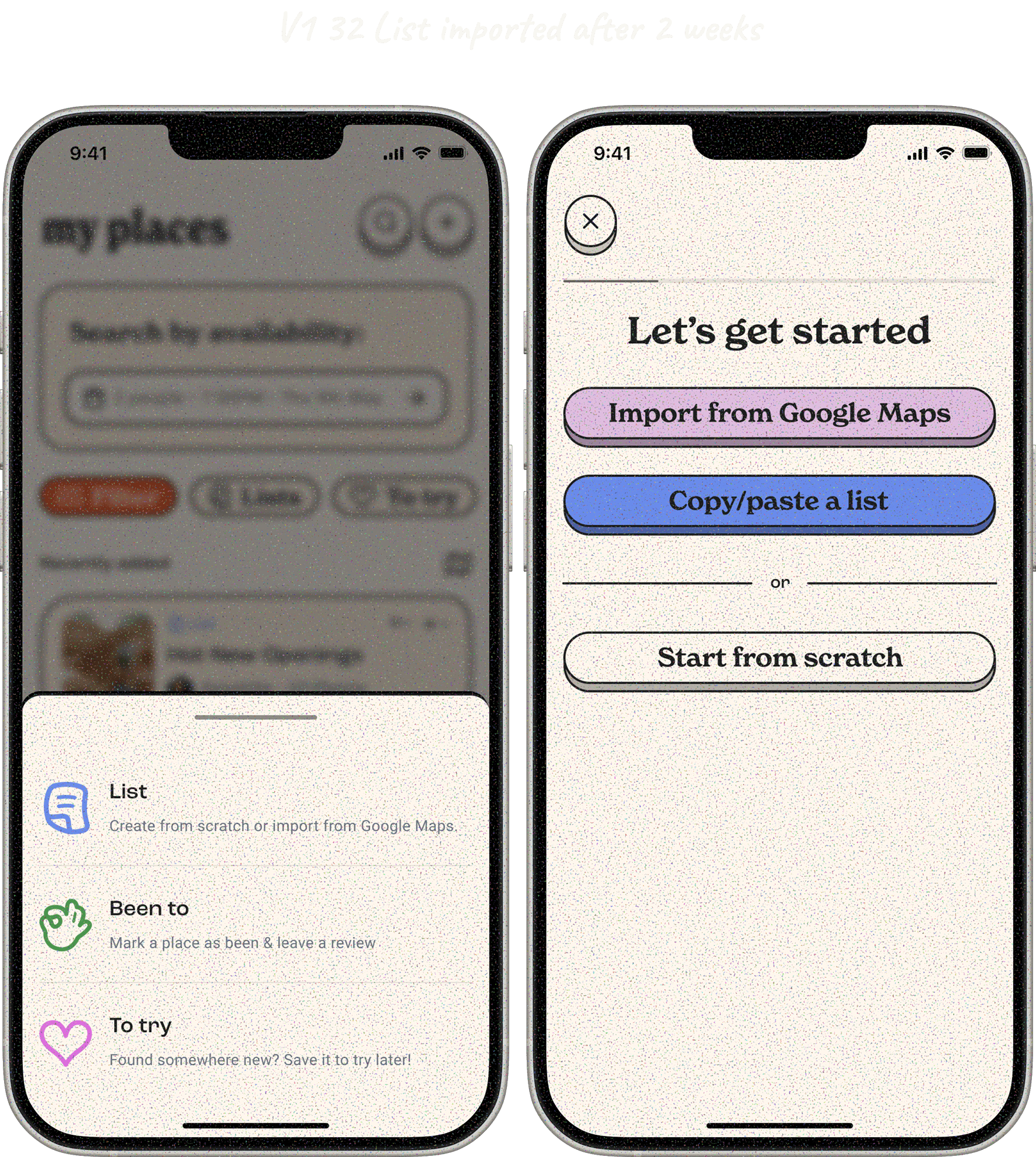
After launching My Places, our core feature for saving and organising restaurants, we weren’t hitting our list creation targets. User research revealed people already had years of saved places in Google Maps and Notes, making it difficult to start from scratch.
We built an AI-powered migration tool to import their existing lists. After launch, we reviewed the data, simplified the migration flow, and turned a small UX change into a significant increase in completion rates.


Final Thoughts
Ambiguity is a design problem too
Figuring out what to build and for who was the hardest design challenge of the project, and the most important one.
Failure is only wasted if you don't use it
The groups feature and AI chatbot both failed. Both directly shaped what worked. We didn't throw the work away, we extracted the insight.
Trust is the product
Users told us early they wouldn't trust V1 with their data. Every decision after that the brand, the animations, the ML recommendations was really about earning that trust back.
Impact
50,000 users in the first year
100,000+ want to tries and been tos
500,000 places saved to lists
48% of want to tries converted to actual visits
Final Thoughts
Ambiguity is a design problem too
Figuring out what to build and for who was the hardest design challenge of the project, and the most important one.
Failure is only wasted if you don't use it
The groups feature and AI chatbot both failed. Both directly shaped what worked. We didn't throw the work away, we extracted the insight.
Trust is the product
Users told us early they wouldn't trust V1 with their data. Every decision after that the brand, the animations, the ML recommendations was really about earning that trust back.
Impact
50,000 users in the first year
100,000+ want to tries and been tos
500,000 places saved to lists
48% of want to tries converted to actual visits
@2026 Command+Z is my best friend.


The groups feature - Iterate, cut
Built as MVP, iterated twice with improved UI and UX each time. Only 15% of users had a live group. Non-foodies won't download a foodie app. We stopped chasing chat and focused on making content easy to share instead.
The AI chatbot — shelved
Built it, tested it with 20 real users. Recommended McDonald's to people wanting authentic local spots. With 18 months of runway we couldn't bet on fixing it. Shelved, but what we learned shaped the next decision.
ML-powered homepage
Took what we learned from the chatbot failure and applied it differently. Foodie Profile Card during onboarding fed the ML model. 1 in 3 saves came from the homepage. Want to try up 25%, saved lists up 30%.
The groups feature - Iterate, cut
Built as MVP, iterated twice with improved UI and UX each time. Only 15% of users had a live group. Non-foodies won't download a foodie app. We stopped chasing chat and focused on making content easy to share instead.
The AI chatbot — shelved
Built it, tested it with 20 real users. Recommended McDonald's to people wanting authentic local spots. With 18 months of runway we couldn't bet on fixing it. Shelved, but what we learned shaped the next decision.
ML-powered homepage
Took what we learned from the chatbot failure and applied it differently. Foodie Profile Card during onboarding fed the ML model. 1 in 3 saves came from the homepage. Want to try up 25%, saved lists up 30%.
The groups feature - Iterate, cut
Built as MVP, iterated twice with improved UI and UX each time. Only 15% of users had a live group. Non-foodies won't download a foodie app. We stopped chasing chat and focused on making content easy to share instead.
The AI chatbot — shelved
Built it, tested it with 20 real users. Recommended McDonald's to people wanting authentic local spots. With 18 months of runway we couldn't bet on fixing it. Shelved, but what we learned shaped the next decision.
ML-powered homepage
Took what we learned from the chatbot failure and applied it differently. Foodie Profile Card during onboarding fed the ML model. 1 in 3 saves came from the homepage. Want to try up 25%, saved lists up 30%.