How Data-Led UX Lifted ANZ's Insurance Page Engagement by 30%
Evolving the Products Brand & Design System at an Early-Stage Startup
Background
ANZ is one of Australia's largest banks. Several of its web pages across Insurance, Superannuation, Retirement, and Personal Bank Accounts were underperforming against key business metrics: application conversions, time on page, and click-through rates.
Understanding the problem
ANZ's insurance and personal banking pages were underperforming on conversions, time on page, and click-through rates. As the sole designer for the first three months, I owned the full process from auditing the existing experience, developing wireframe directions, and running A/B testing through to shipping the final designs.
Goals
Improve clarity and transparency across ANZ's insurance product pages to reduce drop-off, increase application starts, and raise average time on page — without requiring a full platform overhaul.
Role
Sole Product Designer
Timeline
2 Weeks
Team
1 Designer, 1 Engineers, 1 Product Owner
Design Optimisation
Web Design

Research
What the data told us
Before designing anything, I analysed heat map and click data across the underperforming pages to understand exactly where users were engaging and where they were abandoning.
Data range: Dec 2021 - Jan 2022
The “jump to” links were the most engaged element on the page
Desktop recorded 1.9k sessions and 26 clicks. Mobile recorded 370 sessions and 1.3k clicks. Users were actively trying to navigate — but the destination content wasn't meeting them. This pointed to a clear gap between user expectations and the content hierarchy on the page.
The “Types of Home Insurance” was severely underperforming
Despite being the highest-traffic anchor link destination, this section had the lowest engagement of any content block. Users were arriving and immediately leaving — a signal that the content wasn’t answering their question clearly or quickly enough.
Users weren’t reaching the insurance product CTAs
The primary business goal — getting users to start an application — was being blocked by content that was too dense, too early. Users were leaving before reaching any conversion point.
Research
What the data told us
Before designing anything, I analysed heat map and click data across the underperforming pages to understand exactly where users were engaging and where they were abandoning.
Data range: Dec 2021 - Jan 2022
The “jump to” links were the most engaged element on the page
Desktop recorded 1.9k sessions and 26 clicks. Mobile recorded 370 sessions and 1.3k clicks. Users were actively trying to navigate — but the destination content wasn't meeting them. This pointed to a clear gap between user expectations and the content hierarchy on the page.
The “Types of Home Insurance” was severely underperforming
Despite being the highest-traffic anchor link destination, this section had the lowest engagement of any content block. Users were arriving and immediately leaving — a signal that the content wasn’t answering their question clearly or quickly enough.
Users weren’t reaching the insurance product CTAs
The primary business goal — getting users to start an application — was being blocked by content that was too dense, too early. Users were leaving before reaching any conversion point.

Research
What was broken and why
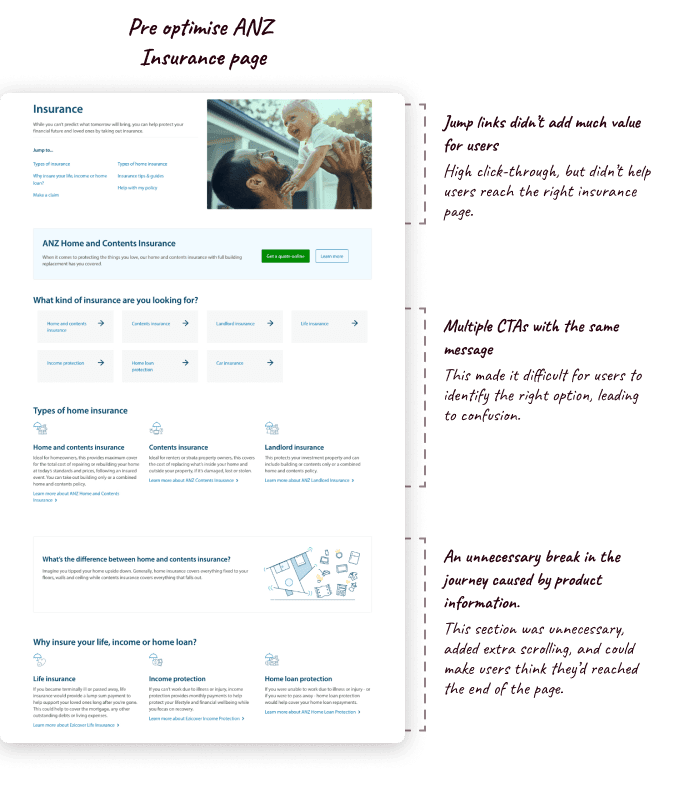
Armed with the data, I conducted a structured heuristic review of the existing insurance pages to diagnose the specific UX failures causing the drop-off.
Repeated and cluttered information
The page contained a high volume of repeated content that made it difficult for users to identify what was relevant to them. Rather than guiding users toward a decision, the layout was overwhelming them with information before they had enough context to act.
Misaligned CTA placement
The “ANZ Home and Contents Insurance” call-to-action was positioned too early in the page hierarchy, before users had built enough understanding of the product. It was being skipped rather than acted on.
A disconnected product in the page
A third insurance product was surfaced on the page without clear contextual connection to the others. Users had no signal that it belonged — creating confusion and reducing trust in the page as a reliable resource.
Both the CTA and the disconnected product findings mapped directly to the data: users weren’t scrolling far enough because the early content wasn't building the confidence needed to continue.
Research
What was broken and why
Armed with the data, I conducted a structured heuristic review of the existing insurance pages to diagnose the specific UX failures causing the drop-off.
Repeated and cluttered information
The page contained a high volume of repeated content that made it difficult for users to identify what was relevant to them. Rather than guiding users toward a decision, the layout was overwhelming them with information before they had enough context to act.
Misaligned CTA placement
The “ANZ Home and Contents Insurance” call-to-action was positioned too early in the page hierarchy, before users had built enough understanding of the product. It was being skipped rather than acted on.
A disconnected product in the page
A third insurance product was surfaced on the page without clear contextual connection to the others. Users had no signal that it belonged — creating confusion and reducing trust in the page as a reliable resource.
Both the CTA and the disconnected product findings mapped directly to the data: users weren’t scrolling far enough because the early content wasn't building the confidence needed to continue.


Solution
The final design & what it achieved
The stakeholders and team aligned on the third wireframe direction — leading with clarity and reducing the cognitive load before the conversion point.
The final design incorporated new illustrations, a placeholder text system using Lorem ipsum for rapid stakeholder iteration, and close collaboration with the marketing team on final copy and imagery.
+30% increase in user engagement across the redesigned pages
4× increase in average time on page — from 2 minutes to 8.8 minutes
Page load time reduced to 6 seconds, improving perceived performance
Reduced revision cycles thanks to structured wireframe feedback and early stakeholder alignment
Measurable gains in application conversion — the primary business KPI for the project
These results came directly from addressing what the data identified at the start: users needed clarity earlier, friction removed from the path to conversion, and content that answered their question before asking them to act.
Solution
The final design & what it achieved
The stakeholders and team aligned on the third wireframe direction — leading with clarity and reducing the cognitive load before the conversion point.
The final design incorporated new illustrations, a placeholder text system using Lorem ipsum for rapid stakeholder iteration, and close collaboration with the marketing team on final copy and imagery.
+30% increase in user engagement across the redesigned pages
4× increase in average time on page — from 2 minutes to 8.8 minutes
Page load time reduced to 6 seconds, improving perceived performance
Reduced revision cycles thanks to structured wireframe feedback and early stakeholder alignment
Measurable gains in application conversion — the primary business KPI for the project
These results came directly from addressing what the data identified at the start: users needed clarity earlier, friction removed from the path to conversion, and content that answered their question before asking them to act.


Final Thoughts
Lead with data, not assumptions
The heatmap findings completely changed the initial brief. Without them, the redesign would have addressed aesthetics rather than behaviour. The most valuable design decision on this project was made before a single screen was touched.
Constraints sharpen decisions
Working as the sole designer under a tight timeline forced prioritisation. Not everything could be redesigned — identifying the highest-leverage interventions became the core skill, and the results reflect that focus.
Stakeholder alignment is a design deliverable
Presenting multiple wireframe directions early wasn’t just good process — it was how the final design got bought in and shipped without significant rework. The time spent aligning early saved far more time later.
Final Thoughts
Lead with data, not assumptions
The heatmap findings completely changed the initial brief. Without them, the redesign would have addressed aesthetics rather than behaviour. The most valuable design decision on this project was made before a single screen was touched.
Constraints sharpen decisions
Working as the sole designer under a tight timeline forced prioritisation. Not everything could be redesigned — identifying the highest-leverage interventions became the core skill, and the results reflect that focus.
Stakeholder alignment is a design deliverable
Presenting multiple wireframe directions early wasn’t just good process — it was how the final design got bought in and shipped without significant rework. The time spent aligning early saved far more time later.
@2026 Moved the button 2px to the left. Perfect now.